When the Price Is Right
But the Paperwork Isn’t:
A Customs Value Lesson
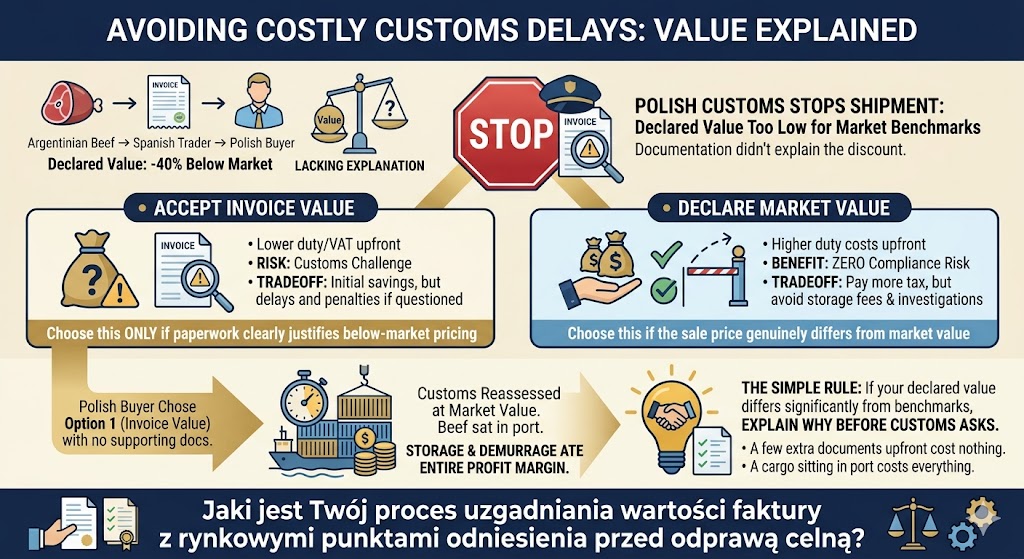
An Argentinian meat supplier shipped premium beef to a Polish buyer through a Spanish trading company. The invoice looked fine — until Polish customs compared the declared value to market rates.
The beef was priced 40% below typical market value for that grade and cut. Why? The Spanish trader had structured the sale to minimise their VAT exposure, but the documentation didn’t explain the discount or the commercial relationship clearly enough.
Polish customs stopped the shipment.
Here’s what happened next:
Here’s the actual sequence of events:
Shipment declared with invoice value — 40% below comparable market rates for premium beef.
System benchmark comparison triggers a review. No supporting documentation explaining the discount or the Spain-Argentina-Poland trading structure.
Duty and VAT recalculated against market value. The buyer now owes the difference, plus the shipment is on hold pending documentation.
Port storage fees and container demurrage accumulate daily while the buyer scrambles to produce letters, contracts, and commercial relationship documents.
By the time the container cleared, storage and demurrage fees had consumed the entire profit margin on the shipment. The invoice was legitimate. The problem was purely documentary.
Had they declared market value upfront or included letters explaining the trading structure, the container would’ve cleared in 48 hours. The rule’s simple: if your declared value differs significantly from comparable shipments, explain why before customs asks. A few extra documents upfront cost you nothing. A cargo sitting in port costs you everything.
The documents that would have cleared it in 48 hours:
The buyer’s invoice was completely legitimate. The price was real. The commercial reason was real. But customs don’t know that unless you tell them — in writing, in advance, in the shipment documentation. Every significant below-market price needs a paper trail. Without one, you’re asking an inspector to take your word for it on a shipment worth hundreds of thousands of euros.
What’s your process for reconciling invoice values against market benchmarks before clearance?
Don’t let paperwork gaps cost you your margin.
Our customs team benchmarks declared values against market data before every shipment. We prepare the supporting documentation package upfront — so your container moves, not sits.
Comments are closed